171 cm to Feet: Exact Conversion, Height Comparison & Everything You Need to Know
So you’ve got a height of 171 cm and you need it in feet. Simple enough question — but there’s actually a lot more to unpack here than just a number.
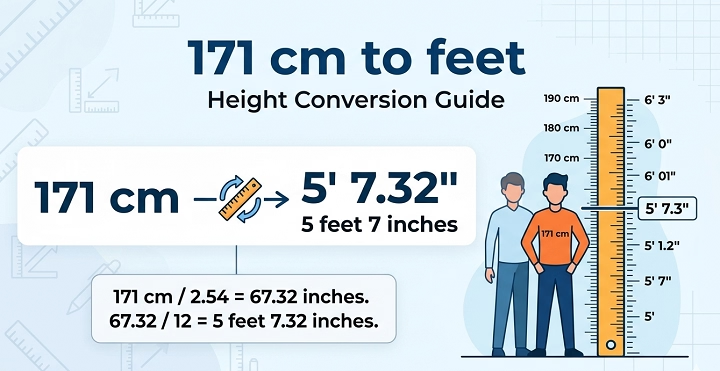
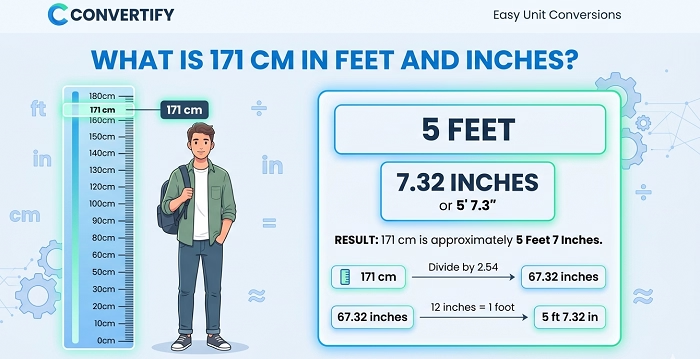
171 cm = 5 feet 7.32 inches (or 5.61 feet in decimal form).
That’s the quick answer. But if you want to understand why that number comes out the way it does, how it stacks up globally, what it means for clothing sizes, sports, and everyday life — keep reading. This guide covers everything in one place.
What Is 171 cm in Feet and Inches?
Let’s get the exact answer out of the way first.
| Measurement | Value |
|---|---|
| 171 cm in feet (decimal) | 5.61 feet |
| 171 cm in feet and inches | 5 feet 7.32 inches |
| 171 cm in inches only | 67.32 inches |
| 171 cm in meters | 1.71 meters |
| 171 cm in yards | 1.87 yards |
Most people round this to 5 feet 7 inches, which is perfectly fine for everyday use. The 0.32 inches barely matters unless you’re dealing with something that requires precision — like medical records or tailoring.
How to Convert 171 cm to Feet: Step-by-Step
You don’t need a calculator every time. Once you understand the formula, you can do a quick mental estimate in seconds.
Method 1: Divide by 30.48 (Most Accurate)
The cleanest way to convert centimeters to feet is to divide by 30.48, because there are exactly 30.48 centimeters in one foot.
171 ÷ 30.48 = 5.6102 feet
To separate that into feet and inches:
- The whole number is your feet: 5 feet
- Take the decimal: 0.6102
- Multiply it by 12 (since 1 foot = 12 inches): 0.6102 × 12 = 7.32 inches
- Result: 5 feet 7.32 inches
Method 2: Divide by 2.54 First (Easier to Remember)
Some people find it easier to convert to inches first, then divide.
171 ÷ 2.54 = 67.32 inches
67.32 ÷ 12 = 5 feet 7.32 inches
Same answer, slightly different path. Use whichever feels more natural.
Method 3: Quick Mental Shortcut
Here’s a rough trick that works well enough for casual use:
- Take your cm value, multiply by 0.0328
- 171 × 0.0328 ≈ 5.61 feet
Not perfectly precise, but close enough when you just need a ballpark.
171 cm in Feet Compared to Nearby Heights
Sometimes you want to see how 171 cm fits relative to other heights. Here’s a handy reference table:
| Height (cm) | Height (ft & in) |
|---|---|
| 168 cm | 5 ft 6.14 in |
| 169 cm | 5 ft 6.54 in |
| 170 cm | 5 ft 6.93 in |
| 171 cm | 5 ft 7.32 in |
| 172 cm | 5 ft 7.72 in |
| 173 cm | 5 ft 8.11 in |
| 174 cm | 5 ft 8.50 in |
| 175 cm | 5 ft 8.90 in |
This table is especially useful if you’re shopping for clothing from international brands where sizes vary by just a centimeter or two.
Is 171 cm Tall? A Real-World Height Perspective
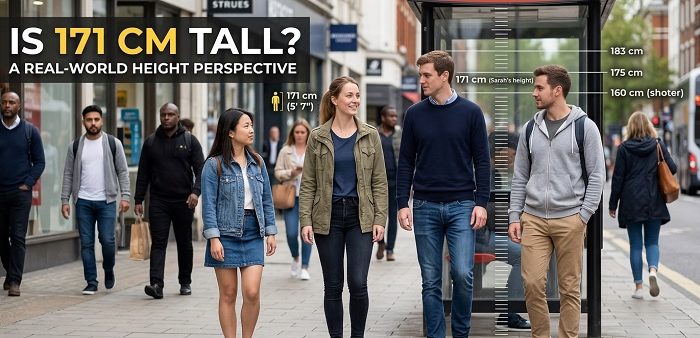
This is where it gets interesting — and where most conversion articles fall completely flat.
The raw number (5’7″) doesn’t mean much without context. Context is everything.
171 cm vs. Global Average Height
Here’s something genuinely fascinating: 171 cm is literally the global average height for adult men. According to data from Our World in Data, the global mean height of adult men born in 1996 is exactly 171 cm (5 feet 7.5 inches). So if you’re a man at this height, you’re right at the world average. Not short, not tall — perfectly in the middle of the bell curve on a planetary scale.
For women, the picture shifts. The global average height for adult women is around 159 cm (about 5’3″). So at 171 cm, a woman would be noticeably taller than the global average for her gender — roughly 12 cm above it.
171 cm vs. Country-Specific Averages
Where you’re from changes everything about how this height is perceived:
| Country | Avg. Male Height | How 171 cm Compares |
|---|---|---|
| Netherlands | ~183 cm (6’0″) | Below average |
| United States | ~175 cm (5’9″) | Slightly below average |
| United Kingdom | ~176 cm (5’9″) | Slightly below average |
| Bangladesh | ~163 cm (5’4″) | Above average |
| India | ~165 cm (5’5″) | Above average |
| Japan | ~171 cm (5’7″) | Right at average |
| World Average | ~171 cm (5’7″) | Exactly average |
So in the Netherlands, 171 cm reads as shorter than most. In South or Southeast Asia, the same height is considered above average. It’s the same number — just interpreted through very different cultural and demographic lenses.
Why Do People Convert 171 cm to Feet?
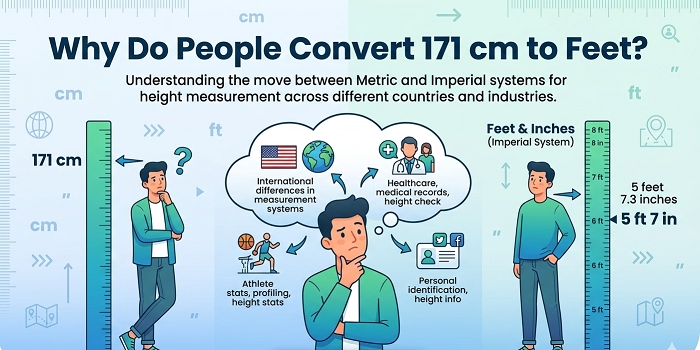
There’s no single reason. People search for this conversion from all kinds of starting points:
- Checking height for a visa or job application that requires measurements in feet
- Online shopping for jeans, dresses, or suits from US or UK brands that list sizes in feet/inches
- Sports — basketball, soccer, and athletics profiles often list height in the imperial system
- Medical forms — especially when traveling to the US, UK, or Canada
- Dating profiles — lots of Western apps default to feet and inches
- Just curiosity — you saw your height in a passport or medical record and wanted the equivalent
Each of these contexts has its own quirks, which is why having a firm grasp of the conversion (not just a one-time lookup) actually saves you time repeatedly.
171 cm and Clothing Sizes: What You Need to Know
Height plays a bigger role in fit than most people realize. At 171 cm (5’7″), here’s what you should generally expect:
For Men:
- Tops/Shirts: Medium or Small depending on the brand and country
- Trousers inseam: Roughly 30–31 inches (76–79 cm)
- Jacket/Suit: Regular length in most European sizing; some US brands may suggest Short
- Jeans: “Regular” inseam from most brands will likely need a slight hem
For Women:
- Dresses/Tops: Medium in most regions; standard length dresses will typically fit well
- Trousers: Regular length in most brands
- Generally considered: “Tall” in many Asian women’s fashion lines; “Average” in European or American lines
The key takeaway here — always check the brand’s specific size guide. “Regular” in one brand could mean something different in another, especially when comparing US, European, and Asian sizing systems.
171 cm in Sports: How Does This Height Measure Up?
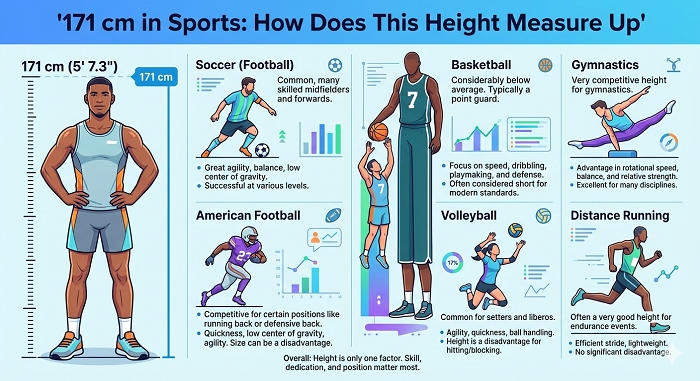
Height matters differently depending on the sport. Let’s put 5’7″ in real sporting context:
- Basketball: 171 cm is on the shorter side for professional play, but not unworkable for guard positions. Several notable NBA guards have been at or close to this height.
- Soccer/Football: Very common height at professional level. Midfielders and wingers frequently fall in the 5’6″–5’9″ range.
- Tennis: Below the typical professional men’s average (around 6’1″), but not unusual for women’s professionals.
- Swimming: Height is a genuine advantage in swimming, so 171 cm is functional but not optimal for elite male swimmers.
- Gymnastics & Martial Arts: Height is often less of a factor or even a non-issue. Many elite gymnasts and martial artists are shorter than this.
The broader point: 171 cm is a very athletic, capable height in most sports. It’s only in a handful of disciplines — mainly basketball and volleyball — where this height starts to become a real limiting factor at the elite level.
Why Two Measurement Systems Still Exist (And Why It Matters)
Most of the world uses the metric system. The United States, Liberia, and Myanmar are the notable holdouts still using imperial measurements for everyday purposes.
This is why conversions like 171 cm to feet still matter in 2025. You’ll encounter both systems regularly in international travel, online shopping, healthcare, and media — especially anything US-produced.
Knowing both systems doesn’t just make you more versatile; it helps you avoid real-world mistakes. Buying jeans based on a wrong inseam conversion? Annoying. Giving an incorrect height on a medical form? That can actually cause problems.
Common Mistakes When Converting cm to Feet
A few errors come up repeatedly when people convert heights:
- Forgetting the inches part. Saying “171 cm is 5 feet” is wrong. It’s 5 feet and 7.32 inches. That missing 7 inches makes a significant difference.
- Rounding too aggressively. Saying “approximately 5.5 feet” when it’s 5.61 feet introduces unnecessary error.
- Confusing decimal feet with feet-and-inches. 5.61 feet is NOT 5 feet 61 inches. The 0.61 needs to be multiplied by 12 to get inches.
- Using the wrong conversion factor. Some people accidentally use 30 instead of 30.48, which gives a slightly off result.
None of these are huge mistakes in casual conversation, but if accuracy matters — for forms, medical records, or tailored clothing — it’s worth getting it right.
FAQ: 171 cm to Feet — Commonly Asked Questions
Q: What is 171 cm in feet and inches? A: 171 cm equals exactly 5 feet 7.32 inches, commonly rounded to 5 feet 7 inches.
Q: Is 171 cm considered tall? A: It depends on context. For men, 171 cm is the global average height. For women, it’s above average globally. In countries like the Netherlands, it would be considered short for a man; in South Asia, it would be above average.
Q: How do I convert cm to feet without a calculator? A: Divide by 30.48 for feet, or divide by 2.54 for inches then divide by 12. A quick mental shortcut is to multiply cm by 0.033 for a rough estimate in feet.
Q: Is 171 cm 5’7 or 5’8? A: 171 cm is 5’7.32″, so it’s closer to 5’7″. You’d need to reach approximately 172.7 cm to round up to 5’8″.
Q: What is 171 cm in feet as a decimal? A: 171 cm = 5.6102 feet, which is commonly rounded to 5.61 feet.
Q: What height in cm equals exactly 5’7″? A: Exactly 5 feet 7 inches = 170.18 cm. So 171 cm is very slightly above a true 5’7″.
Q: How tall is 171 cm compared to the average American man? A: The average American man is about 175.3 cm (5’9″), so a man at 171 cm would be about 4 cm, or roughly 1.5 inches, below the US male average.
Q: Is 171 cm short for a man? A: Globally, no — it’s the world average. In Western countries with taller averages, it may fall slightly below typical adult male heights, but it’s still well within the normal range.