Filetage 1/4 en mm: Conversion, Dimensions, Thread Standards, and Practical Guide
Did you ever stumble on the term filetage 1/4 en mm while shopping for plumbing fittings, camera accessories, air hose fittings, or other threaded equipment?
You can find it all rather confusing. The common assumption is that 1/4 is the same as 6.35 mm, but when you are dealing with threaded fittings, that seldom holds up. In fact, the 1/4 designation has to do with the thread standard, not the actual diameter of the screw or thread, which is why you won’t often see a 1/4 fitting come in at 6.35 mm.
What Does Filetage 1/4 Mean?
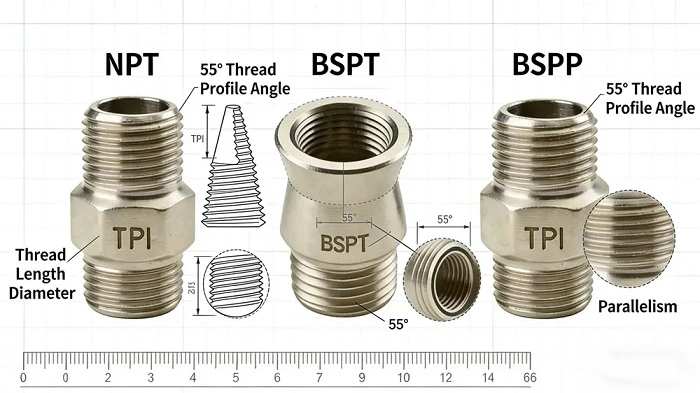
The term filetage is actually French for thread. This means that filetage 1/4 simply refers to a screw or a threaded pipe with a nominal value of 1/4 inch. Depending on the standard, the 1/4 filetage can be BSP, NPT, UNC, UNF, and many others.
Even though 1/4 inch is equal to 6.35 mm, the diameter of the threaded part rarely equals 6.35 mm due to the thread standard.
Here is a conversion chart:
| Measurement | Equivalent |
| 1/4 inch | 6.35 mm |
| Decimal inch | 0.25 in |
| Centimeters | 0.635 cm |
| Micrometers | 6,350 µm |
As mentioned, the 1/4 inch to millimeter conversion only refers to the value of an inch. A 1/4-inch thread is rarely 6.35 mm in diameter due to the thread standard.
Let’s take a look at some of the most common 1/4 thread dimensions.
Common 1/4 Thread Dimensions by Standard
| Thread Standard | Major Diameter | Pitch |
| BSP 1/4 | 13.16 mm | 19 TPI |
| NPT 1/4 | 13.62 mm | 18 TPI |
| UNC 1/4-20 | 6.35 mm | 20 TPI |
| UNF 1/4-28 | 6.35 mm | 28 TPI |
| Camera Thread (1/4-20 UNC) | 6.35 mm | 20 TPI |
As you can see, the 1/4 thread can greatly vary in diameter. It depends on the thread standard.
Why Is It Not Equal to 6.35 MM?
This is actually one of the most frequently asked questions.
Simply put, before the metric system was adopted in most countries, every country had its standard for indicating the nominal pipe size, usually correlated to the screw size. In most cases, the size did not refer to the actual diameter of the screw/thread. In fact, it was a way of denoting the diameter of old wrought iron piping. You can see the effect with a 1/4 BSP thread: it comes to 13.16 mm and not 6.35 mm for that very reason. The 1/4 NPT is no different at 13.62 mm. But take a 1/4 machine screw (UNC or UNF), and you will get 6.35 mm since in that case the diameter is simply the size of the screw itself.
How to Identify Your 1/4 Thread
If you want to identify your 1/4 thread, here are some of the things that you should do:
Measure the Outside Diameter
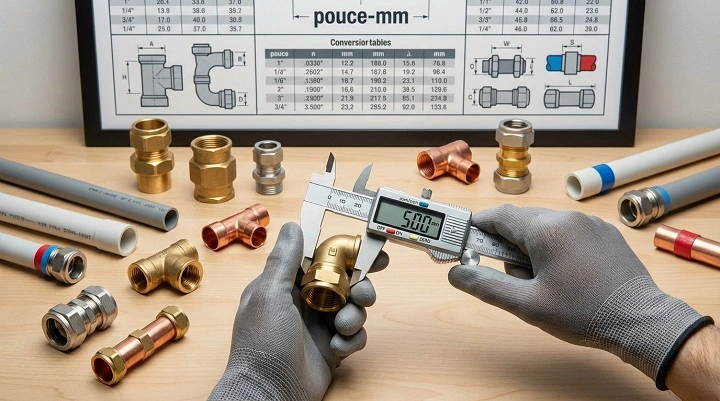
Using a caliper, measure the diameter of your thread in millimeters.
As a rule of thumb:
- 6.35 mm – UNC, UNF, or camera threads
- 13 mm or so – BSP or NPT
Count the Number of Threads per Inch (TPI)
Another important characteristic of a thread is its pitch or the number of threads per inch (TPI). You can measure the TPI using a thread pitch gauge.
- 18 TPI
- 19 TPI
- 20 TPI
- 28 TPI
These are some of the most common TPI measurements for 1/4 thread.
Determine the Intended Use
The intended use of a thread can also be a great indicator of what standard it follows.
Here are some of the most common uses and their corresponding threads:
| Application | Thread Standard |
| Tripods | 1/4-20 UNC |
| Cameras | 1/4-20 UNC |
| Air Compressors | 1/4 NPT |
| Plumbing | 1/4 BSP |
| Hydraulics | BSP OR NPT |
| Industrial Machinery | Varies |
Filetage 1/4 En Mm for Cameras
One of the most common uses of the 1/4-20 UNC thread is for photography equipment. This includes cameras, tripods, gimbals, monopods, quick release plates, ring lights, microphone stands, and action camera accessories among others.
The 1/4 camera thread has a diameter of 6.35 mm and 20 TPI. This standard has been used for decades. That is why most manufacturers adhere to it.
Filetage 1/4 En Mm for Plumbing
One of the most controversial uses of the 1/4 thread is for plumbing. The reason why it is controversial is due to the BSP vs NPT debate.
In short, a 1/4 BSP thread has an outside diameter (OD) of 13.16 mm with 19 TPI. While a 1/4 NPT thread has an OD of 13.62 mm with 18 TPI.
This means that the 1/4 BSP and NPT threads are not interchangeable. Even though they have the same nominal size.
Why Are BSP and NPT Threads Different?
There are several reasons why BSP and NPT threads are different. But the most notable ones are:
- Their countries of origin are different
- Their thread angles are different
- Their areas of application are different
- Their shapes are different
Due to these differences, Their fittings are not considered to be interchangeable.
How to Measure a Thread in Millimeters
To measure a thread in millimeters, you will need the following:
- Digital caliper
- Thread pitch gauge
- Ruler (optional)
Using a digital caliper, measure the outside diameter of the thread in millimeters. You should also count the number of threads per inch and measure the pitch. For better results, use a thread gauge to measure the thread pitch. Once you have the pitch, you can use a standard thread chart to identify the thread.
Everyday Uses of 1/4 Threads
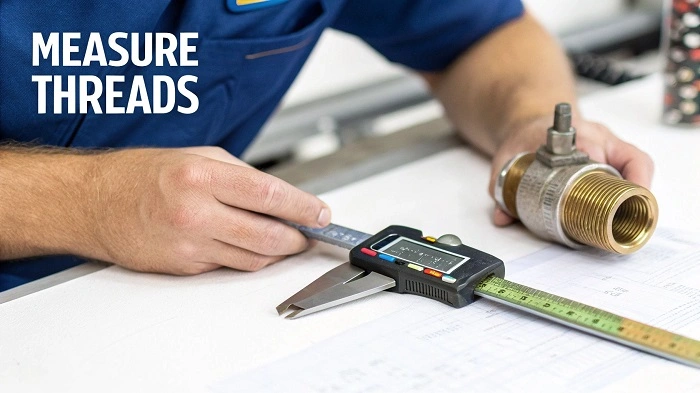
You might be surprised to learn that there are actually many everyday uses of 1/4 threads.
Common applications include:
- DSLR cameras
- Security cameras
- Air hose connections
- Regulators
- Water filters
- Compressor fittings
- Pneumatic tools
- Machine parts
- Workshop equipment
- Lighting stands
Once you know how to measure a 1/4 thread. Then you can easily identify it and find the right accessory for it.
Common Mistakes
When dealing with this size threads, here are some of the most common mistakes that people tend to make:
- Thinking that 1/4 always equals 6.35 mm
- Not counting the number of TPI
- Confusing BSP and NPT
- Measuring the diameter incorrectly
- Buying the wrong fittings
- Forcing incompatible fittings together
The best way to avoid these mistakes is by learning how to measure a 1/4 thread.
Summary
By now, you should have a good understanding of what filetage 1/4 en mm means. And also how to determine the size of a 1/4 thread.
As a recap, remember that the value 1/4 usually refers to the thread standard rather than the diameter of a screw/thread. Depending on the standard, the 1/4 thread can greatly vary in size. For example, 1/4 BSP, NPT, have an outside diameter of 13.16 mm and 13.62 mm. On the other hand, the outside diameter of the 1/4-20 UNC, UNF, and camera threads are equal to 6.35 mm.
Another thing that you should remember is that you can identify a 1/4 thread by its diameter, the number of threads per inch (TPI), and thread standard. Usually, the application can be a good indicator of what standard your thread follows. For example, 1/4-20 UNC threads are mostly used for cameras, but 1/4 BSP/NPT are used for plumbing.
It is essential to know that determining the filetage 1/4 en mm is by no means simply converting 1/4 to 6.35 mm. Indeed, it is necessary to consider that the value of the 1/4 thread depends considerably on the standard. For the United States and countries that use the imperial system of measuring, the closest metric equivalent to the 1/4-20 UNC and its cousins 1/4-20 UNF is 6.35 mm. Meanwhile, the 1/4 BSP and NPT are predominantly used in plumbing and possess an outside diameter of 13.16 and 13.62 mm respectively. By knowing the differences between the standards, one could avoid buying unsuitable connections and other complications.
Whenever possible, it is always advisable to measure the outside diameter and TPI of the threaded connection to know its size beforehand. Furthermore, it is always a good idea to have a ruler or thread pitch gauge on hand to measure the pitch in case of a need arising. This knowledge will help select the needed adapter, if any, to connect different types of threads.